



Dave Burroughs on the state of psychosocial risk in Australian organisations
Page Published Date:
June 18, 2026
"We can't simply associate a big brand or lots of activity with maturity": Dave Burroughs on the state of psychosocial risk in Australian organisations
Dave Burroughs is the Founder and Principal Psychologist at Australian Psychological Services (APS), a national firm he established in 2010 specialising in psychological health and safety. APS works with organisations across Australia and internationally, bringing together a team of senior psychologists focused on evidence-based job design and psychosocial risk management. Dave is also the current Chief Mental Health Officer at Westpac.
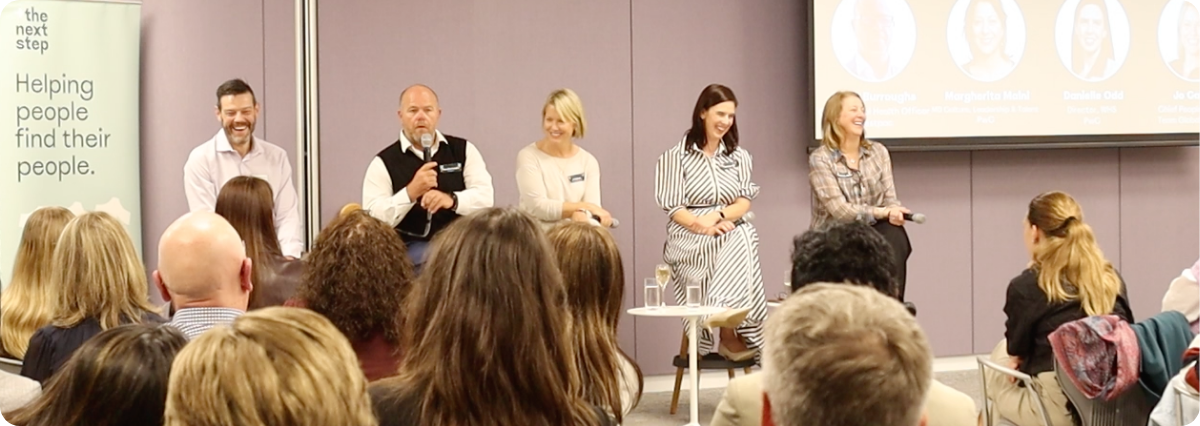
The following is drawn from Dave's contributions at a panel event hosted by The Next Step and The Safe Step at PwC's Barangaroo offices. His remarks have been lightly edited for clarity and were made as part of a broader panel discussion with senior HR and safety leaders from PwC and Team Global Express.
Is psychosocial risk a safety problem, an HR problem, or a leadership problem?
Dave doesn't hesitate on this one. It's all three and treating it as any one of them in isolation is where organisations go wrong.
"Whose job is it? It's everybody's job. The regulations sit within safety — it's part of the Health and Safety Act.
But a lot of the controls, and actually the design of work, is the responsibility of HR. Unless there's absolute collaboration across both,
I just don't know how anyone does this well."
He pushes back on the idea that managing psychosocial risk and driving performance are somehow in tension.
"From a safety perspective, the more that we can identify and remove the barriers to wellbeing —
the things that have the potential to cause harm — the more we're also removing the barriers to performance, productivity,
and engagement. There's almost a false dichotomy in trying to put it into two different camps."
In Dave’s experience, the real risk isn't regulatory. It sits across EVP, retention, reputational risk, counterproductive workplace behaviour, and business continuity. Organisations that treat psychosocial risk purely as a compliance obligation are, in his view, missing the strategic case entirely.
How mature are Australian organisations at managing this?
Working across dozens of organisations through APS, Dave has a rare vantage point. His assessment is candid.
"[It’s] very rare to find one that I'd say is at a high level of maturity. And don't associate a big brand with maturity."
He describes the challenge as structural rather than intentional. Most organisations are genuinely trying. But psychosocial risk is a moving target; new pressures like AI-driven change, restructuring, and workforce transformation keep shifting the landscape underneath organisations that thought they had it handled.
"It's like an old pair of shoes you keep slipping into. But it just changes every now and again, with things like AI transformation, organisational change – these aren’t little things where we can rely on HR process and approaches of old."
What does poor job design actually cost?
This is where Dave's consulting work produces numbers that tend to change the conversation. One APS case study he shared in detail involved a large senior leadership team presenting with friction, overwork, and requests for more headcount.
"The typical organisational response is: there's friction, let's have a team building day. And maybe we recruit more people."
APS took a different approach. Using a psychosocial job design lens, they mapped what the work actually looked like across the group.
"What we found was that the work overload was associated with lack of role clarity. The lack of role clarity was associated with poorly managed organisational change. Across the leadership group, there were thousands of hours every week lost to what we call ‘hindrance work’ due to the lack of role clarity and incivility emerging due to role overload."
Senior leaders within businesses don't often put in psych injury claims. But by using a psychosocial job design lens, we were able to show the financial and workload impact that is often never quantified in this space."
The case illustrates something Dave comes back to: the most significant psychosocial risk in many organisations is invisible to the people managing it, because they're not looking at the right indicators or don’t fully understand the impact of job design.
What about the claim that "we're a high-performance organisation"?
Dave’s direct response is shaped by years of seeing what high-performance labels cover for.
"It means everyone's going to have a really close look at what you do. So often we see the words ‘high performing’ as an excuse for pushing people to work excessive hours and relying on the discretional effort of good people to compensate for poorly designed or scoped work or unrealistic expectations.”
Dave warns against relying on elite sport analogies that rely on things like rest and recovery, these are simply not effective controls for sustainable high performance or minimising the risk of mental health harm in the workplace. If you understand the difference between people’s orientation to work (i.e, Job, Carer, Calling), human motivational theory and the differences between what’s required for short-term, periodic competition versus sustainable contribution, you can see why the analogy doesn’t really hold water.
What should organisations look for when choosing a partner in this space?
This is an area Dave feels strongly about. Since the psychosocial regulations came into effect, the market has filled rapidly with providers claiming expertise.
"Everyone's on LinkedIn. I've seen so many people become psychosocial risk experts overnight, since the regulations came in.
There's dodgy providers and snake oil salesmen out there all over the place."
His criteria for assessing any provider are specific:
- Many diagnostics currently on the market are not academically or independently validated.
- Some rely on occupational hygiene models that were never designed for psychosocial risk and are simply not fit for purpose in this context.
- And any provider recommending organisations focus exclusively on their top three risks is, in Dave's view, giving dangerously incomplete advice.
"Psychosocial hazards have a cumulative and interactive component. If you're looking at something in isolation from all the other hazards, you are going to get it wrong. Just be mindful of who you listen to. There's a lot of really noisy people out there.
here's not a lot of people who actually know what they're doing."
It's notable that when Danielle Odd, Director of Wellbeing, Health and Safety at PwC, was asked who she admired in the space, she named Dr Laura Kirby, who serves as Executive Director and Chief Psychologist at APS.
Where should organisations start?
Dave's practical entry point is looking at the maturity of your psychosocial safety system, and how integrated your approach is across the employee life cycle recruitment, HR, L&D, WHS and Injury management. He also highlights the importance of line managers and one-up leaders as the ‘first line of defence’ against psychosocial harm, and also the biggest influence on people’s overall experience of work.
Understanding job design, from standing up new teams, redesigning work that’s not working well, to empowering leader and individuals to optimise their work is key to moving beyond basic compliance to genuine performance.
Dave recommends following the likes of Professor Arnold Bakker and his research if you are genuinely interested in evidence-based practice in areas such as job design.
For organisations wanting to understand where they sit, or to start quantifying the cost of their current psychosocial risk profile, Australian Psychological Services can be reached at consultaps.com.au.
Looking for a new role?
Search HR jobs
Need help filling a position?
Contact Us
Other articles you might be interested in

How do you choose the right recruitment agency? The Next Step explores what to look for when deciding on an HR partner for talent sourcing.

AI has made it easier to look like a strong candidate-not to be one. Here's why specialist recruiters still outperform high-volume screening.

Five signals from the talent market suggest business confidence is returning - from rising TA hiring to senior roles being filled. Read what it means.