



What Boards really need from HR and how leaders can step up
Geraldine Doyle
Page Published Date:
March 30, 2026
Last week, HR and safety leaders gathered at MinterEllison's Brisbane offices for an evening of frank conversation about one of the most pressing challenges in the profession: how do people leaders communicate in a way that actually resonates at Board level?
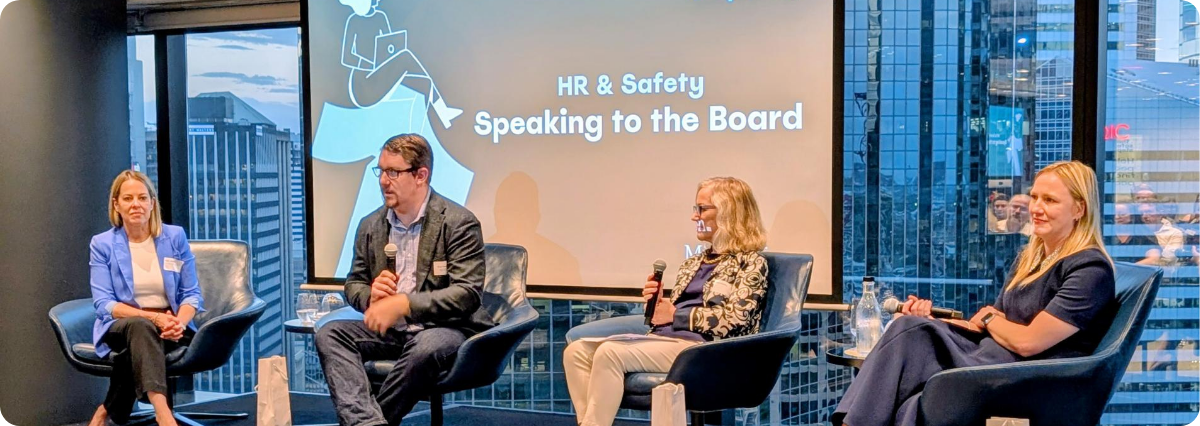
Co-hosted by The Next Step, The Safe Step and MinterEllison, the event brought together an exclusive panel with rare depth of perspective: a workplace law partner, a seasoned Board director with an HR background, and a Head of ESG and EHS overseeing a billion-dollar portfolio. What emerged was not a polished set of talking points, but a candid reckoning with where the HR profession is falling short and what it needs to do differently.
The Star Entertainment fallout
Unsurprisingly, the conversation began where many governance discussions are beginning right now: with the ASIC v Star Entertainment Group judgment. Deanna McMaster, a partner at MinterEllison specialising in workplace health and safety, was direct about what it means for HR and safety professionals.
"Best practice psychosocial reporting is now four to five pages… with quality due diligence, prepared together by HR and safety.
It's sometimes hard to collaborate, but this is going to be the space where we're going to have to get on with it."
— Deanna McMaster, Partner, MinterEllison, speaking at the event
The judgment has given Board directors and their Chairs explicit permission to send papers back when the information is too voluminous or too dense to enable good decision-making. Jane Keating, who brings over a decade of senior HR leadership at Queensland Treasury Corporation and now serves on multiple Boards, was clear about the practical implication.
"I firmly believe that writing one page is much harder than writing ten pages.
You've really got to give people the ammunition to make a good decision."
— Jane Keating, Board Director, speaking at the event
Jane described attending a Board meeting where the pack ran to 450 pages. By the next meeting, it had been reduced to 225, which was “still too much.”
The 'What, So What, Now What' formula
So what does good reporting look like? Jane offered a framework she has used consistently to cut through: 'What, So What, Now What'. The 'What' is your data, like turnover, workers’ comp claims or retention metrics. The 'So What' is what it means — the trend, the risk, the implication. The 'Now What' is what your team is going to do about it.
It sounds simple. But as every HR leader in the room knew, translating complex people data into a coherent narrative that a Board can act on is genuinely difficult and most organisations are not yet doing it well.
The commercial credibility gap
Wade Needham, Head of ESG and EHS at Natural Resources, offered perhaps the most challenging perspective of the evening: a frank assessment of why so few HR professionals make it to the top table.
"The degree might get you the job, the experience might get you the role...
You don't get listened to [by the board] unless you earn their respect and solve their problem.
You get paid commensurate to the problems you solve for senior leaders."
— Wade Needham, Head of ESG and EHS, speaking at the event
Wade questioned whether HR leaders understand the commercial language of the business well enough to translate people risk into enterprise risk. Do they know the margin profile of their industry? Can they articulate what a workers' compensation saving is worth in terms of contract value? Do they go to other functions with solutions or wait for others to come to them?
"Are you forcing people to come to you or are you going to them?
That's the single biggest thing I can test at a manager level and at a director level."
— Wade Needham, speaking at the event
What separates operational from strategic
Jane spoke candidly about what she looks for and what she has coached her own teams and mentees on. Confidence, body language and being prepared to answer questions without defaulting to your notes all make a big difference to the impression you leave on a board. She described watching a direct report present to a Board. This person was technically thorough and deeply prepared, visibly thrown by an unexpected question.
“I said to her afterwards: ‘If you had leaned in, said that's a great question and offered to follow up, it would have been 180 degrees different.’ She would have produced exactly the same information, but the impression she left would have been completely different.”
Deanna added that the best Board presenters she has seen share one quality: they are not slaves to their plan. They know the two or three things they need to communicate, and they stay on track, even when the Board tries to take them somewhere else.
A profession at a turning point
The picture that emerged across the evening was the opportunity for HR to be a key enabler for organisations. Regulatory changes focused on worker wellbeing, like psychosocial safety, the right to disconnect and work from home mandates, are putting people risk front and centre. The Star judgment is changing what Boards expect from those who report to them and the talent pipeline of HR leaders who can operate credibly at governance level needs consistent investment.
The opportunity, as every panellist made clear, is real. HR leaders who develop commercial acumen, master the art of concise and strategic reporting and build genuine cross-functional relationships are increasingly indispensable.
This event was co-hosted by The Next Step, The Safe Step, and MinterEllison in Brisbane, March 2026. The Next Step partners with organisations across Australia to find and develop outstanding HR and people leadership talent.
Looking for a new role?
Search HR jobs
Need help filling a position?
Contact Us
Other articles you might be interested in
Analyze HR job trends & skills demand in Australia. Get insights for job seekers & employers. Download the report today!

Senior HR Recruitment Consultant Erin Hogan shares her observations on Melbourne's HR contracting market, and the hesitancy of current candidates.

AI may have changed how candidates apply for jobs, but it hasn't changed what makes a great hire.
Explores the rise of AI-generated applications, the challenges they create for employers, and why human judgement remains critical to identifying genuine capability, fit and potential. Learn