Human-Led, AI-Enabled: What HR Leaders Took Home from Melbourne
Lisa Hammond
Page Published Date:
April 23, 2026

On a busy Melbourne morning, HR and people & culture leaders gathered for The Next Step's Human-Led, AI-Enabled breakfast event. The panel conversation and networking opportunity was designed to move well beyond the hype and into the practical, the principled and the human.
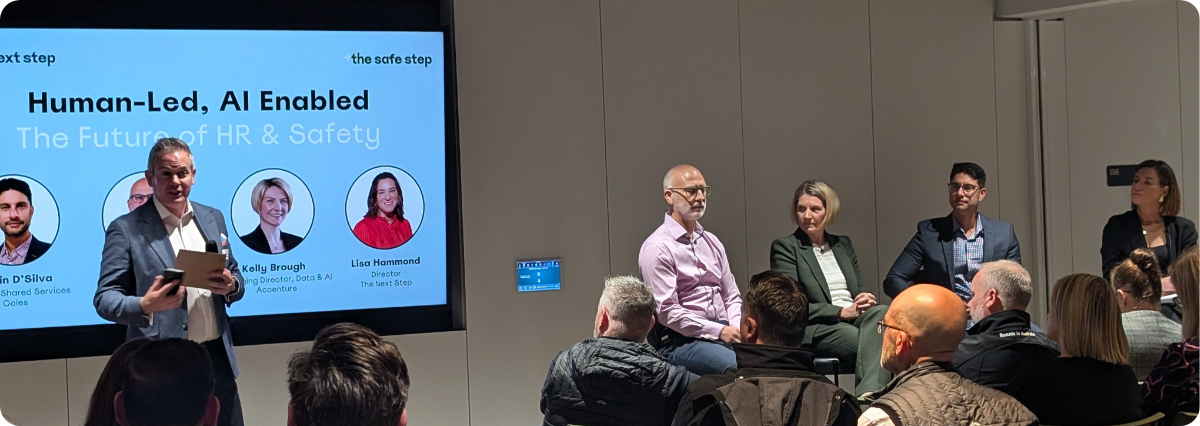
The room was packed with senior professionals who had come not for theory, but for real experiences. What's working, what isn’t, where the guardrails need to be, and how to build something sustainable in organisations of all shapes and sizes.
Three senior leaders shared their experience: Davin d'Silva, General Manager of People and Culture Shared Services at Coles Group; Mark Lipman, Head of Enterprise Risk at Qantas; and Kelly Brough, Managing Director of AI and Data at Accenture Australia and New Zealand. The conversation was rich, candid, and full of the kind of nuance that only comes from people who've actually done it.
Start with the Problem, Not the Technology
Perhaps the clearest message of the morning came early, and it came from both the HR and safety sides of the panel: don't start by asking how to use AI. Start by asking what problem you're genuinely trying to solve.
Davin d'Silva put it plainly. At Coles, with 115,000 team members across 800 supermarkets, 900 liquor stores, distribution centres and corporate functions, the People & Culture team was fielding approximately 50,000 queries a year, and 65% of those were questions that had answers already available somewhere on the intranet.
"The cost of doing nothing: the P&C team was spending their days on Tier 1 work when they got out of bed to do Tier 2 and Tier 3 —
the work that needs judgment, empathy and compassion."
A time-and-motion study revealed that self-servicing that 65% could unlock somewhere between 20,000 and 30,000 hours of capacity per year. The solution was a GPT-4 powered chatbot built on Azure, piloted over three months and released in June last year. The results are compelling, with quarter-on-quarter reductions in self-serviceable tickets and adoption rates that have turned early users into internal advocates.
Trust is Built Before Launch, Not After
One of the most important themes of the morning was that trust, both in the product and among the workforce, is imperative for a successful launch.
Davin outlined four disciplines that shaped their approach: engaging governance stakeholders (risk, cyber security, privacy, responsible AI councils) from the very start; locking down scope tightly and not deviating from it; being explicit about where human judgment would always remain in the loop; and setting clear, non-negotiable success criteria before going live.
"Don't let the pressure of releasing product push you to 'close enough'.
If you don't get it to the right level upfront, the adoption rate will never hit, and it takes a long road to bring it back."
Coles was deliberate about what their chatbot would and wouldn't do. Just because AI can do something doesn't mean it should. That boundary-setting was as much ethical as technical.
Where AI Is Making a Real Difference
The panel shared concrete examples of AI lifting outcomes in people and culture contexts. At Coles, the OIC staff (responsible for payroll processing in stores) emerged as the heaviest users of the chatbot and its greatest beneficiaries. The ability to get fast, accurate answers in the payroll window has directly reduced off-cycle payments and exemptions, improving compliance and doing right by team members. "You want to do the right thing by your team member each and every time," Davin said, "and this is a really practical example of where AI is helping people get the right information quickly."
At Accenture, Kelly described an agent designed simply to assess whether incoming work had all the data needed to be completed. The agent was inserted between the business and a processing team and reduced unworkable workload by 15%, accelerated turnaround times, and freed capacity to clear a substantial backlog.
The Skills HR Leaders Need to Build Now
When the conversation turned to capability, it was striking how consistent the answer was across very different organisations. The skills that matter most in an AI-augmented environment are not technical. They are human.
Kelly framed AI adoption around five imperatives: leading with value, reinventing both work and the workforce that supports it, investing in digital foundations, acting responsibly, and committing to continuous learning.
Davin pointed to a long-overdue shift. Leaders have historically been promoted into roles and then loaded with administrative tasks, with the added expectation to also lead people. AI is beginning to change that, and leaders of tomorrow will be hired and developed for decision-making, empathy, and coaching. "I don't think we've ever really enabled our leaders," he said. "AI will push off the administrative load and let them focus on how they make a real difference for their people."
Mark added a note of caution. As junior staff spend less time on the administrative work that has historically built their judgment and professional instinct, organisations need to think carefully about how that judgment is cultivated. "Decision literacy" a the capability worth investing in now.
Key Takeaways for HR Leaders
- Start with the problem: resist the pressure to find an AI use case for its own sake. Identify the genuine pain point first.
- Invest in responsible AI governance early: engage your risk, privacy, cyber and ethics stakeholders before you build, not after.
- Set non-negotiable human boundaries: be explicit about where human judgment, empathy and context will always remain in the process.
- Measure adoption, not just output: a tool people don't use is a problem, not a solution. Set the right success criteria and hold to them.
- Develop your leaders for what AI can't replace: coaching, empathy, decision-making, and contextual judgment are the capabilities that will define people leadership in the years ahead.
The Next Step works with HR and people and culture leaders across Australia to identify, develop and place the talent that makes organisations thrive. If you'd like to continue the conversation about building AI-capable teams and cultures, we'd love to hear from you.
Looking for a new role?
Search HR jobs
Need help filling a position?
Contact Us
Other articles you might be interested in