



The Future Workforce is already here - what it means for HR
Page Published Date:
November 16, 2026
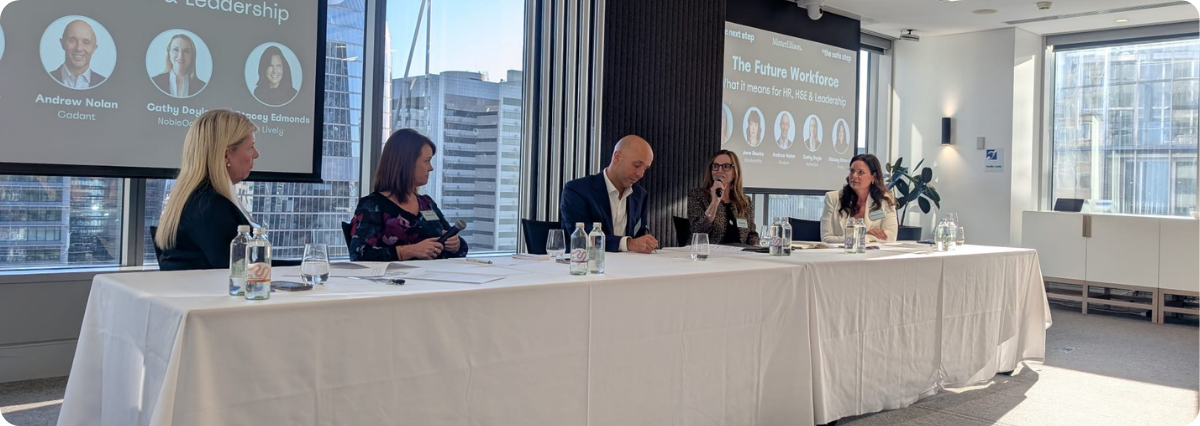
On Wednesday 4 November, The Next Step and The Safe Step partnered with MinterEllison to host The Future Workforce: What It Means for HR, HSE and Leadership in Sydney.
Kristy Edser from MinterEllison facilitated a panel of Jane Bourke, Director of Safety, Health & Wellbeing at Woolworths; Andrew Nolan, who helps organisations turn AI ambition into practical adoption; Cathy Doyle, CPO at NobleOak; and Stacey Edmonds, founder of Lively.
The panel agreed on one thing early.
The future of work is happening now, and HR is in the middle of it. Here are the key takeaways for HR professionals.
Key Takeaways for HR:
1. Work is moving from producing to checking
Andrew Nolan shared examples of organisations where AI now drafts most of the output. In one professional services firm, agents produce first drafts of dozens of transaction documents from a recorded client interview. The people in the business now review that work.
"Our job is to check the output of AI, and I think we'll move in this direction more and more as agents and models get better." Andrew Nolan
This has real implications for job design and engagement. Checking work feels different to producing it. Andrew also pointed out that review capacity, rather than licences, is now the constraint.
"Everyone has a plan to increase licences and get people across AI. But no one has a plan about how you can check that work,
or what that looks like for the people." Andrew Nolan
2. Junior roles are shrinking quietly
The panel discussed a drop in entry-level and graduate hiring. Andrew described this as a change most businesses haven't decided on deliberately. Managers simply aren't backfilling junior roles because AI is handling the work.
This creates a pipeline risk. Junior roles are where people build the judgment they'll need to review AI output later. Kristy Edser said the legal profession is already grappling with it.
"The challenge for us is still getting the lawyers in the door but getting them on to better work sooner." Kristy Edser
For HR, the question is how to design graduate and early-career programs that transfer judgment and insight when the traditional grunt work has gone.
3. Culture is shifting
When people ask an AI tool instead of the colleague beside them, informal learning changes. Andrew noted that many of us learned by overhearing how others handled a call or a problem. Cathy Doyle offered a different lens.
"I wouldn't use the word eroded. I'd say it's shifting." Cathy Doyle
Cathy described setting expectations for AI agents in the same way organisations set them for people, including how they should think and behave. HR remains the custodian of making sure culture is fit for purpose.
4. AI governance needs to go beyond a policy
Stacey Edmonds asked the room how many people had an AI policy, had read it, and understood it. Many employees use one tool at work and another at home, and sensitive data can end up in public tools.
"It's more than a policy." Stacey Edmonds
Stacey's advice was to know what tools your people are using, and to offer learning they can take home to their families. She grouped governance into three areas: AI used about your people, AI used by your people, and AI-enabled attacks on your people.
5. Sentiment data can become surveillance
Andrew shared an example of a large organisation considering replacing pulse surveys with daily sentiment analysis of emails, meetings and messages. Managers would receive daily reports on who seemed engaged and who didn't.
Cathy said a proposal like this would not pass her organisation's ethical AI review.
"You can't do away with it, but you shouldn't replace it with an automated model Cathy Doyle, on employee surveys
The technology to do this is already available in many workplaces. HR will need a clear position on what is ethical and how that data is used.
6. Leaders need courage
Asked what good leadership looks like now, the panel pointed to timeless qualities. Andrew said boards are pushing for fast action on AI, and leaders need the courage to slow down when something doesn't feel right.
"For me, that's going to be the major leadership quality in the next 12 to 24 months." Andrew Nolan, on courage
Jane Bourke added one more.
"Knowing that you don't have the answers, and being okay with that.
It's about bringing the right skill sets together to work collective on path forward" Jane Bourke
Stacey encouraged leaders to build a working understanding of the technology and the data behind it.
7. HR is back in work design
Cathy's advice was to map your workflows and identify where AI changes the loop. That understanding then informs workforce design, including new roles and skill sets.
"Good old HR might have to get back into work design. Just when you think you're out of it, you're back in it." Cathy Doyle
WHAT HR CAN DO NOW
- Plan for review capacity as well as AI adoption. Look at how much checking your people can realistically do, and how that affects their roles and wellbeing.
- Test your graduate and junior hiring decisions. Ask why fewer roles are being requested, and what that means for your future talent pipeline.
- Make your AI policy practical. Communicate it, train on it, and understand what tools your people are using.
- Set an ethical line on employee data before the technology sets it for you.
- Work with HSE. Psychosocial risk, culture and work design now sit across both functions.
Merridy Thomas closed the evening with a reminder that HR and HSE professionals will help lead this transformation, and that connections across both functions matter more than ever.
"Your network will be your most important thing for your future." Merridy Thomas
Looking for a new role?
Search HR jobs
Need help filling a position?
Contact Us
Other articles you might be interested in

Even a ‘just coffee’ catch-up counts. Geraldine Doyle shares practical interview preparation tips to help HR leaders build rapport and stand out.

Why Psychosocial Risk requires collective and collaborative ownership

What Hassell's 2026 Workplace Report Means for HR Leaders | The Next Step